Go Into All The World
For instruction shall go out from Zion,
and the word of Yahweh from Jerusalem.
And they shall not learn war anymore. (Is 2:3-4)
You will be my witnesses in Jerusalem,
and to the farthest part of the earth. (Ac 1:8)
We have seen the three distinctive features of the Way of Life, belief in Life over Death, Provision over Hoarding, and Jesus over Caesar. The obvious next question is: Why does Jesus ask people to live like this? What's the purpose? What is the expected outcome?
What are the strategic objectives of the King of Sky and Dirt?
Caesar's objectives are well understood: keep what Rome has, take what others have. If soldiers die, that’s the way it is. Against this, why does Christ the king ask His people to live this way? What is the purpose of the faithful life or the martyr's death?
The conflict between the powers and the faithful did not end with Rome.
Let me tell you a story. Stories are how we understand the world.
It is the year 1511 CE1. A group of Dominican Friars are on the island of Hispaniola, governed by Diego Columbus, son of Christopher Columbus. They have lived in a grass hut in someone's backyard for 15 months. In that time they have seen and heard horrors and brutality beyond belief. Women often abort or kill their babies to save them from the horrors they are living. All to fill Spain with gold and feed her soldiers' conquest.
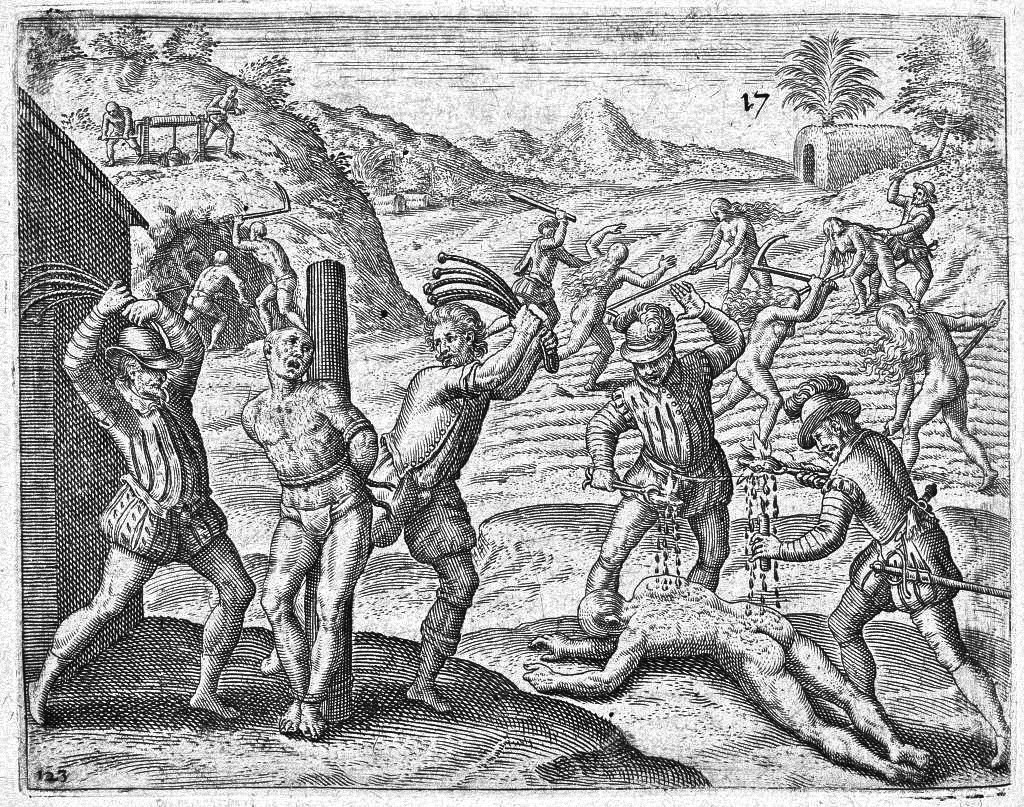
After much prayer and deliberation they write a sermon and sign their names to it, they select Friar Antón Montesino as the one to deliver the message. When the day arrives Friar Montesino ascends the pulpit. "I have come up here, I who am the voice of Christ crying in the wilderness of this island."
"This voice says that all of you are in mortal sin, and in it you live and die, because of the cruelty and tyranny you practice against these innocent peoples. Tell me: by what right or by what justice do you hold these Indians in such cruel and horrible servitude? By what authority have you waged such detestable wars against these peoples?"
"How can you keep them so oppressed and worn down, without giving them food or tending them in their illnesses, so that from the excessive labor you lay upon them they fall sick and die - or rather, you kill them - in order to extract and acquire gold every day?"
"Are these not men? Do they not have rational souls?2 Are you not bound to love them as yourselves? Do you not understand this? Be assured that in the state you are in, you can no more be saved than the Moors or Turks who lack and will not accept the faith of Jesus Christ."
Governor Columbus and the other slave keepers are enraged. They demand that Montesino retract his sermon, as though that would change the laws of God. The Friars eventually agree that Friar Montesino will return next Sunday and "endeavor to satisfy them and explain all that had been said."
The following Sunday Friar Montesino ascends the pulpit again and opens with "I will begin again from the beginning to set forth my knowledge, and I will prove that my words are without falsehood."
He preaches an even more fiery sermon than the first, condemning their evil a second time.
Columbus sends letters to the king complaining "that their preaching was nothing other than stripping the King of his sovereignty and his revenues in these parts."
Does it seem strange to you that the friars respond with teaching?
Don't people who have done such horrible things deserve to die? Shouldn't someone be killing them for their crimes?
Isaiah looked forward to this:
Instruction will come from Zion;
the LORD’s word from Jerusalem.
God will judge between the nations,
and settle disputes of mighty nations.
Then they will beat their swords into plows
and their spears into pruning tools.
Nation will not take up sword against nation;
they will no longer learn how to make war. (Is 2:3–4)
Notice the sequence of events?
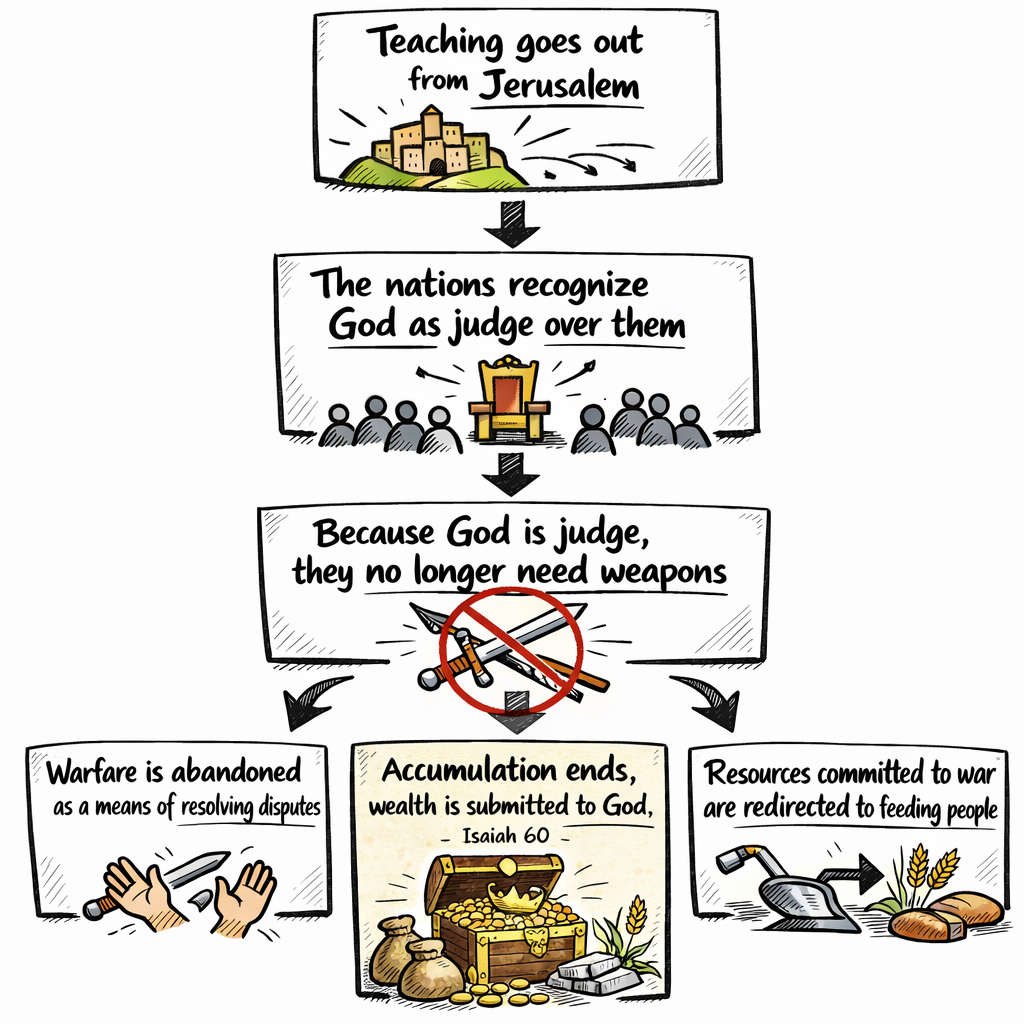
Isaiah 2 looks forward to a time when teaching going out from Jerusalem will end war. Isaiah 60 adds that the wealth of the nations will be brought to God. This is a voluntary response to understanding, not capitulation in the face of superior firepower.
After Jesus' resurrection he commissions his disciples to go teach, inaugurating this healing of the nations, telling them:
Go and make disciples of all the nations,
teaching them to observe everything I have commanded you (Mt 28:18-20)
For it is written that the Christ will be proclaimed
to all the nations, beginning from Jerusalem (Lk 24:44-49)
You will be my witnesses in Jerusalem,
and in all Judea and Samaria,
and to the farthest part of the earth. (Acts 1:8-9)
“Peace to you. As the Father has sent me, I also send you.” (Jn 20:19-23).
Jesus sends them with peace, as the Father sent him. Not conquering with armies and swords, but with teaching and self-giving love. The book of Acts ends with Paul "laying siege" to Rome "proclaiming the kingdom of God and teaching the things concerning the Lord Jesus Christ (Ac 28:31)".
The Dominican friars reach for teaching because the church does not defeat evil by becoming like it, but by teaching its followers to put down their weapons. To love their neighbors and their enemies instead of killing them.
You cannot out murder the devil, but if you strip him of his followers he has no power.
How can teaching overcome evil, overcome the power of the sword?
What did the friars hope to accomplish with their sermon?
They hoped to change the colonists' belief about their native neighbors. Bartolome De Las Casas, the author who recorded the sermon, did eventually repent, and free his slaves. Human belief has the power to reshape the world.
When Cyprian's church believed in love of neighbor and enemy, the sick received care, the dead were buried, the hungry were fed. When Polycarp believed that Death had died the power of Caesar over him was broken. When Ephrem believed in provision instead of accumulation the poor were fed. When Marcellus believed in Jesus as Lord of lords instead of Caesar there was one less soldier to kill Rome's neighbors.
The promised teaching goes out, carried by the church (Lk 24:49). Beliefs about Death, provision, and kingdom change, and the principalities and powers are broken (1 Cor 15:20-26).
In the mind of the apostles, the ingathering of the nations to God has already started:
"You have come to Mount Zion, and to the city of the living God, to the heavenly Jerusalem, to the festal gathering and assembly of the firstborn who are enrolled in heaven, and to God the judge of all (Heb 12:22–23)"3
Justin Martyr, writing in 155 CE, says of Isaiah 2: "It did so come to pass, we can convince you. For from Jerusalem there went out into the world, men, twelve in number, and these illiterate, of no ability in speaking: but by the power of God they proclaimed to every race of men that they were sent by Christ to teach to all the word of God; and we who formerly used to murder one another do not only now refrain from making war upon our enemies, but also, that we may not lie nor deceive our examiners, willingly die confessing Christ4"
The teaching goes out, not as empty words, but as the Life of Christ in the church. How dishonest, how empty, would words proclaiming trust in this Life be if they were carried by people who lived by the sword?
The purpose of our commission by the King of Sky and Dirt is this: To abolish all rule and all authority and power. To put all his enemies under his feet (1 Co 15:24–25). Not feet that hurry to shed blood, but feet that bring the good news of peace. The Kingdom of Sky and Dirt is here, not with swords and bloodshed, but with embodied teaching and love.
Teaching what? That God's Life is stronger than Death. That God's provision is more trustworthy than hoarding. That Jesus is Lord of the kingdom of Sky and Dirt, and Caesar is not. When the nations understand the teaching, warfare will end, the hungry will be fed, and the striving of human kingdoms will cease.
Can we find these people in the scripture? Are these ideas really "according to all the scripture and the prophets"? Let's collect ourselves and make sure we know where we are, then turn to Genesis, where I think we find our three themes present in the beginning.
Contemplation Questions
Remember, sit with the question and listen, don't try to answer it.
Does changing the world through preaching sound naive and foolish?
God was pleased through the foolishness of preaching to save those who believe. (1 Co 1:21) The foolishness of God is wiser than human wisdom (1 Co 1:25)
Does rejecting violence sound vulnerable and weak?
The weakness of God is stronger than human strength. (1 Co 1:25)
I don't know how this can work. But who do I trust? Caesar, who tells me that his Death, power, and violence are necessary to keep me safe? Or the God of Love who tells me that the only safety is in His Life?
Who do you see teaching the nations to reject violence and warfare?
Footnotes:
-
This retelling is based on Book III Chapters III - VIII of Bartolome De Las Casas' Historia de las Indias (vol. 2 de 5). I am working from this English translation ↩
-
He is speaking here in terms of Thomas Aquinas' Summa Theologiae, Part I, Question 93 which identifies the image of God with the human capacity for reason. e.g. Q 93 Article 4 "man is said to be the image of God by reason of his intellectual nature." ↩
-
See also: "You are a holy nation, a people for God’s possession, so that you may proclaim the virtues of the one who called you out of darkness into his marvelous light (1 Peter 2:9)" and "He gave birth to us through the message of truth, so that we should be a kind of first fruits of his creatures. (Jas 1:18)". ↩
-
Justin Martyr, Apology, Chapter 39 ↩