The Value of Wealth
This is the sin of your sister Sodom: She and her daughters were proud, had plenty to eat, and enjoyed peace and prosperity; but she didn’t help the poor and the needy. (Eze 16:49, CEB)
In Two Ways we saw the first distinguishing feature between the Way of Life and the Way of Death, how people relate to the power of Death. The second is how people treat wealth. To understand the spiritual logic of the Way of Life we must first remember what wealth is.
Let me tell you a story. Stories are how we understand the world.
It is the year 372. Ephrem is a deacon living in Edessa, where he fled when his home city was surrendered to the Persian Empire. Edessa is in the grip of famine and people are starving.
Ephrem is incensed. He knows that there is enough food in the city to feed everyone, but the rich are hoarding what they have for themselves and leaving the poor to die. He finds the rich men and rebukes them. He tells them that in hoarding their wealth while their neighbors starve they put their very souls in jeopardy. Are not their riches rotting their very souls if they cling to them while their neighbors are in need?
The rich men protest, "We are not intent on hoarding our wealth, but we don't know of anyone we can entrust to distribute our goods. Everyone is intent on enriching themselves, our trust will be betrayed and we will be defrauded!"
"What do you think of me?" asks Ephrem. When they admit that he is an excellent and good man, and completely trustworthy, he offers to distribute their contributions to the poor and starving. They accept him and he has 300 beds set up in public porches for those who need healing. He works to care for those suffering from the famine until it ends. Then he returns to his living quarters, where he dies a few days later1.
I wonder if any of the rich men helped him in his work.
What Ephrem understands is that wealth is not money, wealth is access to resources necessary to sustain life.
When we believe in the ultimate and unassailable power of Death in the world we organize our lives around the futile attempt to protect ourselves from it. Jesus tells a parable of a rich man who plans to tear down his barns to build bigger ones (Luke 12:13-21). The rich man thinks his hoarding will save him, saying to himself "Relax, eat, drink, celebrate!" But Death comes for him and his hoards do not save him.
By contrast, when we trust in the Life of the Father and His provision we can freely feed those around us without fear that we will not have enough (John 6). This is the lesson of the manna in the wilderness. A source of life that Israel cannot hoard, they must trust in God's life and provision for each day.
When we feed the hungry, clothe the naked, provide for the least of these, we are sustaining life in the world and driving back the forces of Death. Polycarp says "Giving assistance to the poor rescues a person from death"2. Providing for the poor is not good works for public performance, it is participating in the work of Jesus driving Death out of the world3.
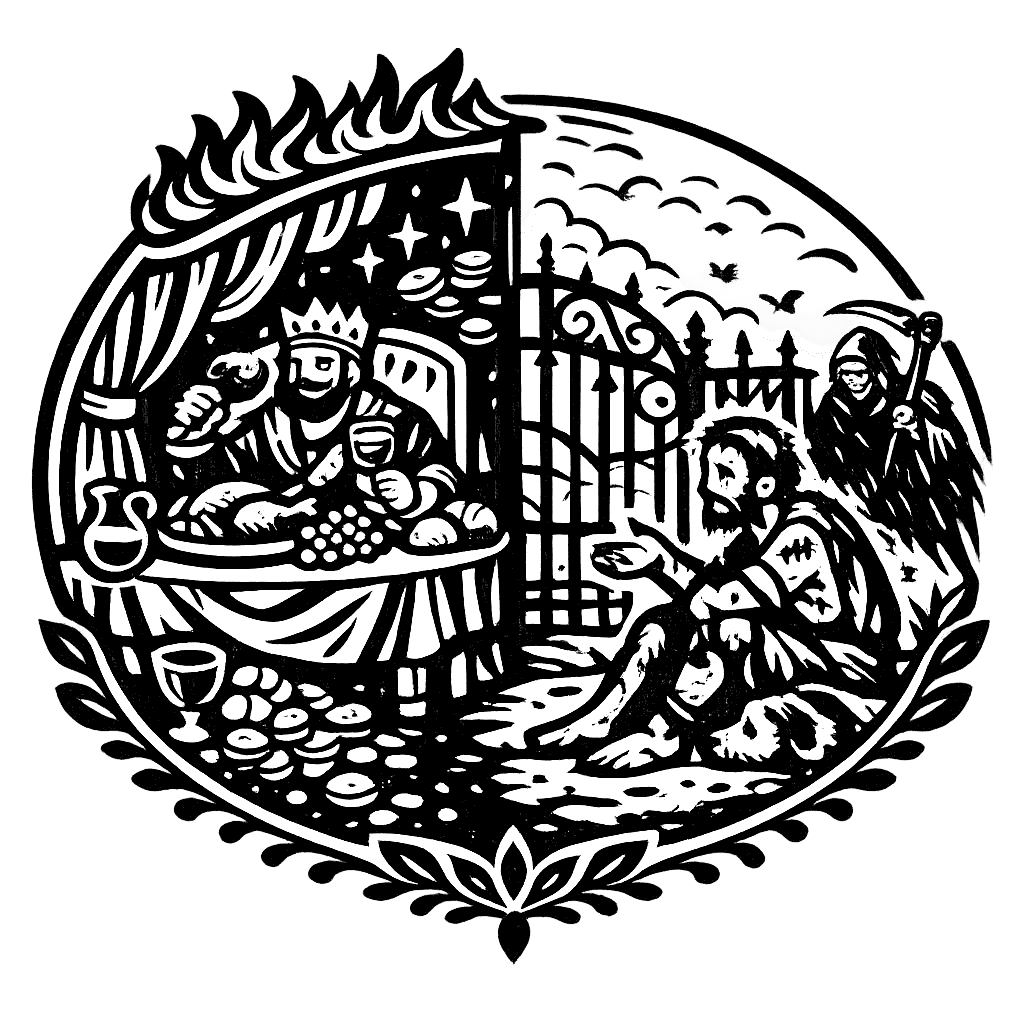
In the scripture the pursuit of wealth is not a neutral act. We will explore the law and the prophets, but Jesus makes this clear. In Luke 16:19-21 he tells the parable of the rich man and Lazarus. The rich man feasts every day, Lazarus outside his gate, longs for the scraps that fall from his table. When they die, Lazarus "goes to Abraham's bosom", and the rich man is cast into Hades. Now, you might say that the rich man's crime was not pursuit of wealth, but in his lack of provision for Lazarus. But if he cared for Lazarus, how was he so rich? Basil of Caesarea writes in his sermon "To the Rich"4 that someone who truly loves their neighbor as themselves cannot become wealthy, because they would have spent their wealth on their neighbors in need. Not piling it up into riches. If I wish to accumulate wealth I must hand over my hungry neighbors to death every day, as I walk past them at my gate.
Jesus himself points to his care for the poor and the sick as proof of his messianic claim. When John the Baptist sends his disciples to ask Jesus "are you the one, or should we look for another?" Jesus responds "Go and tell John what you have seen and heard: the blind receive sight, the lame walk, lepers are cleansed, the deaf hear; the dead are raised, the poor have good news announced to them." (Lk 7:22)
Jesus cares for the sick to defend them from Death.
Jesus feeds the hungry to defend them from Death.
Jesus loves his neighbors and his enemies to heal the world of Death.
And his people, as his body, participate in his healing of the nations (Eph 1:21-23, Rev 22:2).
The final line of Jesus response to John's question is "blessed is the one who doesn't fall away because of me." John is sending this question from Herod's prison, and Jesus is not going to rescue him from Herod by the power of the sword. Jesus is conquering Death, not making covenants with it. Blessed is the one who does not look for another who does.
Jesus does not believe that the life God breathed into the people around him is subject to the power of Death or worthless in a world ruled by Death. He values life and brings healing where Death has brought harm. Jesus trusts in God's provision, not in dead gold or silver.
This is the second of the three distinguishing features of the Way of Life. Living out of the belief that the life and provision of God is enough for me to feed my neighbors in need, participating in Jesus' healing of the nations, following him on the Way of Life.
Next we'll look at citizens and kings.
Contemplation Questions
Remember, sit with the question and listen, don't try to answer it.
Yahweh enters into judgment with the elders of his people and its princes. “And you! You have devoured the vineyard; the spoil of the poor is in your houses! Why do you crush my people and grind the face of the poor?” (Is 3:14–15 LEB)
If we admire the rich man, praise him and follow after him, where is he leading us? Down the Way of Life? Or the Way of Death?
If I preach the right of a rich man to his money
what am I saying to the One who said "sell your possessions and give to the poor"?
Footnotes:
-
Wikipedia: Ephrem, Primary Source Available Online; Chapter 16. Concerning St. Ephraim. ↩
-
Polycarp to the Philippians 10, quoting Tobit, an apocryphal book quoted by a number of early church leaders as scripture. Tobit 4:10 ↩
-
For an extended look at this idea see Jesus and the Forces of Death ↩
-
"Now, you are obviously very far from having observed one commandment at least, and you falsely swore that you had kept it, namely, that you’ve loved your neighbor as yourself. For see: the Lord’s commandment proves you to be utterly lacking in real love. For if what you’ve claimed were true, that you have kept from your youth the commandment of love, and have given to each person as much as to yourself, how has it come to you, this abundance of money? For it takes wealth to care for the needy: a little paid out for the necessity of each person you take on, and all at once everything gets parceled out, and is spent upon them. Thus, the man who loves his neighbor as himself will have acquired no more than what his neighbor has; whereas you, visibly, have acquired a lot." -- Basil To The Rich (I think in the Biblical text, and to some extent in Basil, we see the critique of wealth aimed primarily at those who no longer have "dirt under their fingernails". People who live entirely on the rents and labor of others. By contrast, for example, Boaz is clearly wealthy, but we see him working with his labors and sleeping in the barn.) ↩