Two Ways
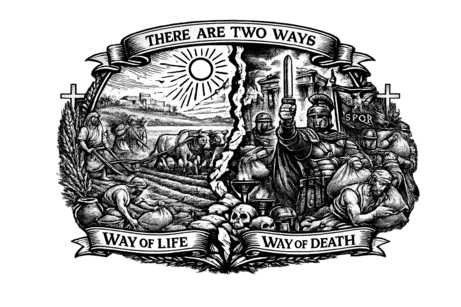
There are two ways, one of life and one of death;
and great is the difference between the two ways
(The Didache1)
Before we can go looking for the life of the early church in the scripture we need to know what we're looking for.
- The offspring of the serpent and the offspring of the woman (Gen 3)
- The way of the wicked and the way of the righteous (Ps 1)
- Some trust in chariots and some trust in the name of the Lord (Psalm 20)
- The way that leads to destruction and the way that leads to life (Mt 7)
- Feet that are swift to shed blood and feet that bring good news of peace (Rom 3:15, 10:15)
- The way of life and the way of death (The Didache 1)
What is the great difference between these two ways? What are the distinguishing markers of walking one or the other?
Let me tell you a story. Stories are how we understand the world.
It is the year 155 CE2. Herod, a peace officer in the city of Smyrna, is steeling himself for combat. He and his men are approaching the farmhouse where Polycarp, the local leader of a group of dangerous subversives, is hiding. He's been teaching his followers that Caesar is not to be worshiped, that he is not king of kings and lord of lords. That those titles belong to a dead Jewish man executed by the empire over a century ago. He has his followers swear a sacramentum oath to this Jesus as soldiers in the legions swear to Caesar3.
Imagine how this sounds to a Roman peace officer. Blasphemous nonsense, but dangerous.
Some of Polycarp's followers were executed by wild animals, and one young man had pulled an animal to himself to hasten his own death. What would such people be like when armed and defending their leader? Herod has many armed men with him on horseback, he will be okay.
One of the youths they tortured leads them to the house and they dismount. As they approach an ancient old man comes out and greets them. He tells them that he is Polycarp and invites them inside to share a meal, during which he requests time to pray before leaving with them. He stands and prays for two hours.
Herod puts Polycarp in his own carriage for the trip to the stadium where the trial will be held. Herod tries to convince him to play along with the Proconsul, asking "what harm is there in saying 'Caesar is Lord' and offering a little incense to be saved?" Polycarp refuses.
At the stadium the Proconsul encourages him 'Have regard for your age. Swear by the divine spirit of Caesar; change your mind and say, “Away with the atheists!"' Polycarp turns to the crowd of Caesar worshipers, waves his hand over them, and says "Away with the atheists!". In doing this he declares that if he worships Caesar as they do, then he will be worshiping no God.
The Proconsul sentences him to be burned alive.
Polycarp's followers interred his bones and celebrated his victory over the unjust ruler.4
When reading about the early church the first thing that jumps off the page is their relationship to the power of death. These do not seem to be people who sing "death is swallowed up in victory" on Sunday, and then live the other six days ruled by it.
This unusual relationship has two facets
The first is that the church does not acknowledge death as a power over them. Herod and the Proconsul both believe that their power to kill Polycarp gives them authority over him and who he worships. Polycarp rejects this idea, even mocking their worship of the emperor. After Polycarp is murdered his followers mourn the loss of their teacher, but celebrate his victory. His death is not viewed as a final act of defiance, but as victory!
The second facet is that the church does not view wielding death as real power. In spite of recurring persecution and brutality there are no surviving accounts of Christians retaliating in violence against their persecutors. Quite the opposite. In 197 CE Tertullian, after listing all the ways Christians have been abused, can say "what single case of revenge for injury are you able to point to?" Tertullian then goes on to assert that Christians' lack of fear of death would enable them to take violent revenge "if in our religion it were not counted better to be slain than to slay."5
How does this make sense?
After naming our three markers we will turn to searching the scripture, for now I will gesture at a single story and a few hooks.
I want you to recall Jesus abduction in the garden.
A mob of live-by-the-sword people come to arrest Jesus. Peter attacks, trying to defend him. Jesus stops him, and heals the live-by-the-sword violence of Peter's actions. Everyone here knows that if Jesus leaves with this mob, they will murder him.
In the middle of this scene Jesus says "those who live by the sword will be destroyed by the sword (Mt 26:52)".
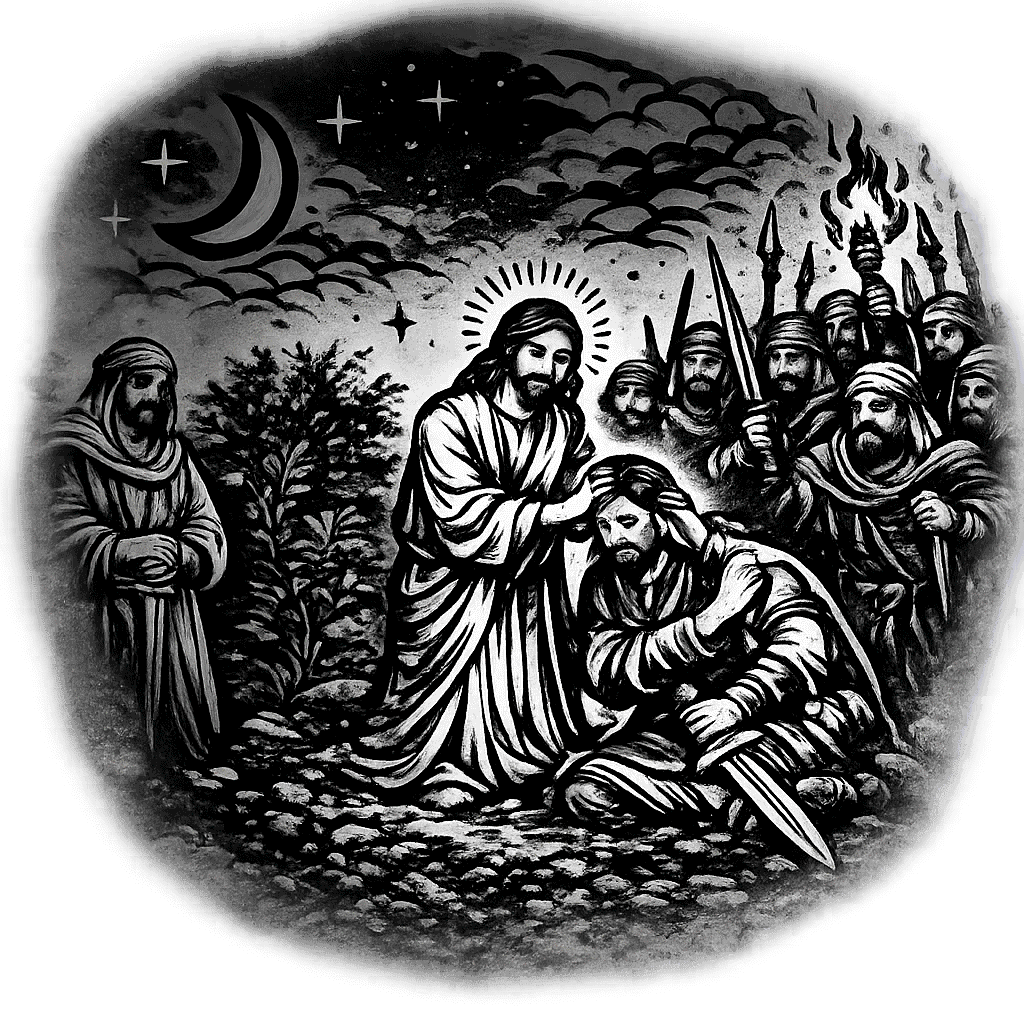
Try to let the bizarre strangeness of this moment sink in. Jesus will be murdered by these live-by-the-sword people. But they are being destroyed by the sword? Not Jesus?
Is Jesus speaking in riddles? Or is he speaking the simple truth? Does he mean that when you make a covenant with death (Is 28:15), the power of the sword, you will be consumed by it? That making an alliance with Satan's power of death (Heb 2:14) is the way that leads to destruction?
This is the first of three distinguishing features of the Way of Life. Living out the belief that the power of death has been broken by Jesus. Those wielding deathly power do not have power over those who have the Life of Jesus in them. Those who have been reborn in the new creation do not pursue power and authority through alliances with death. (Heb 2:14, Rom 6:8-11, 1 Cor 15:12-34, many others).
We'll name the other two features in subsequent essays. Next, we'll talk about wealth.
Contemplation Questions
Remember, sit with the question and listen, don't try to answer it.
The weakness of God is stronger than human strength (1 Cor 1:25)
Where in your society do you see people covenanting with death, wielding the power of the sword? To what purpose? Where do you see people refusing alliance with death, even in the face of violence against them?
If I am a temple to the One who destroyed Death,
can I build an altar to Death in that temple?
Will the Spirit that breathes Life into all things reside beside such an altar?
Will I not be left as a whitewashed tomb?
Beautiful on the outside but filled with death and violence.
Footnotes:
-
The Didache is an early church manual usually dated to sometime in the first century CE. Wikipedia ↩
-
The date is debated. Britannica ↩
-
The Martyrdom of Polycarp does not have these specific details, but we know that this is the basic shape of the Roman view of Christians. The letter from governor Pliny to the Roman emperor Trajan is a short example that covers all these points. The origin of the word sacrament is sacramentum which had a number of legal functions, but at this time was primarily an oath sworn by soldiers joining the Roman legions.Wikipedia, Britannica, Caesar and the Sacrament ↩
-
The Apostolic Fathers in English; A version The Martyrdom of Polycarp chapters 3,6-12,18-19 ↩